Selecting a reliable nickel alloy shaft forging factory is a critical decision that directly impacts the performance, safety, and longevity of your rotating equipment. Whether you are sourcing components for aerospace turbines, marine propulsion systems, oil and gas drilling assemblies, or high-speed industrial machinery, the quality of the forged shaft determines operational efficiency and downtime costs. With the global nickel alloy forging market projected to exceed USD 9.2 billion by 2026, driven by increased demand in the energy transition and additive manufacturing sectors, the need for rigorous supplier evaluation has never been greater. This article provides a structured, data-backed approach to evaluating forging manufacturers, covering material standards, process capabilities, quality certifications, and commercial considerations. By following this framework, you can identify a partner that delivers consistent metallurgical performance, dimensional accuracy, and long-term value—without falling into common pitfalls like cost-driven trade-offs or incomplete technical reviews.
Understanding Nickel Alloy Grades and Application Requirements
Before engaging with any forging factory, you must define the specific nickel alloy grade required for your shaft application. Common grades include Inconel 625, Inconel 718, Hastelloy X, Monel 400, and Nimonic 80A, each offering distinct resistance to corrosion, creep, and thermal fatigue. For example, Inconel 718 maintains tensile strength above 1,200 MPa at 650°C, making it suitable for gas turbine shafts, while Hastelloy C-276 excels in chemical processing environments with pitting resistance equivalent number (PRE) above 40. A competent forging factory should demonstrate documented experience with the exact grade you specify, including evidence of prior melt source traceability and heat treatment cycles. Ask for material test reports (MTRs) from their suppliers and verify that the alloy meets ASTM B637, AMS 5663, or equivalent international standards. The factory must also consider the shaft's final service environment—whether it involves hydrogen embrittlement risk, cyclic thermal loading, or sour gas exposure—to recommend appropriate forging ratios and post-forge thermal processing.
Evaluating Forging Process Capabilities: From Ingot to Finished Shaft
A robust nickel alloy shaft forging factory employs multi-stage forming techniques that preserve microstructural integrity. The process typically begins with vacuum induction melting (VIM) followed by electro-slag remelting (ESR) or vacuum arc remelting (VAR) to minimize segregation and non-metallic inclusions. For large-diameter shafts (e.g., over 500 mm), open-die forging with hydraulic presses rated at 2,000 tons or higher is standard, while closed-die forging offers better dimensional control for complex geometries. The factory should document their forging ratio—ideally between 3:1 and 5:1 for nickel alloys—to ensure grain refinement and eliminate cast dendritic structures. Ask about their ultrasonic testing (UT) capabilities during the forging process, including phased array UT for detecting subsurface defects down to 0.5 mm flat-bottom hole equivalent. Additionally, confirm that they maintain strict temperature control during upsetting and drawing operations, as nickel alloys have narrow hot-working windows (e.g., 1,050°C to 1,150°C for Inconel 718). A credible manufacturer will provide time-temperature charts for each heat pass.
Quality Assurance Systems and Certifications to Verify
Industry-specific certifications are non-negotiable for nickel alloy shaft forging factories serving critical sectors. At a minimum, the factory should hold ISO 9001:2015 certification, but more relevant are AS9100D for aerospace, API 6A or API 20B for oil and gas, and IATF 16949 for automotive applications. Verifying these certifications through third-party databases (e.g., IMS or SAI Global) ensures current validity. Beyond certificates, evaluate their in-house destructive and non-destructive testing (NDT) capabilities. Look for a factory that performs Charpy V-notch impact testing at cryogenic temperatures, stress corrosion cracking (SCC) tests per ASTM G36, and fatigue testing per ASTM E466. Their NDT suite should include magnetic particle inspection (MPI), liquid penetrant inspection (LPI), and eddy current testing for surface flaws. A best-in-class factory will also have ISO 17025-accredited metallurgical laboratory with scanning electron microscopy (SEM) and energy-dispersive X-ray spectroscopy (EDS) for inclusion analysis. Request sample reports from previous projects to verify data presentation standards.
Assessing Manufacturing Lead Times and Supply Chain Resilience
Supply chain volatility in recent years has highlighted the importance of a factory's raw material sourcing and inventory strategy. For nickel alloy shafts, lead times can range from 12 to 28 weeks depending on alloy availability and forging complexity. A factory that maintains a strategic stock of commonly used grades—such as Inconel 625 round bars or custom-dimension billets—can reduce your procurement risk. Inquire about their relationships with primary melters like Special Metals, Haynes International, or VDM Metals, and whether they have alternative suppliers to avoid single-source dependency. Additionally, evaluate their capacity for rapid prototyping using near-net-shape forging combined with rough machining. A flexible factory should offer expedited NDT and certification turnaround (e.g., 3‑5 days) for urgent orders. During the factory audit, check their order backlog and actual vs. planned shipment performance over the past 12 months. Factories with less than 85% on-time delivery should raise a red flag. Don't forget to discuss shipping logistics: heavy nickel alloy shafts often require specialized crating, moisture-barrier packaging, and temperature-controlled containers for overseas transport.
Cost Structure and Total Cost of Ownership Considerations
Avoid choosing a forging factory solely based on piece price. The total cost of ownership (TCO) includes raw material costs (which can account for 40–60% of the total), forging and heat treatment energy costs, post-forge machining allowances, inspection fees, and potential rework costs from non-conformance. Request a detailed cost breakdown that separates alloy surcharges, forging labor, heat treatment cycles (e.g., solution annealing plus aging), rough machining, and final NDT. Compare quotes from multiple factories, but also consider value-added services like full finish machining (which eliminates your secondary operations) or in-house coating (e.g., hardfacing or chrome plating). For long-term contracts, negotiate price adjustment mechanisms tied to the London Metal Exchange (LME) nickel price index, as nickel prices have shown historic volatility with annual swings exceeding 30%. Also, evaluate the factory's warranty policies: many reputable manufacturers offer a standard 12-month warranty against material and process defects, with extended warranties available for premium-priced shafts. Jianing Forging, for example, structures its commercial terms to reward long-term partnerships, offering volume discounts and shared inventory programs for strategic clients. (咨询热线:176 9623 6479)
On-Site Audit Checklist: What to Inspect During a Factory Visit
A virtual evaluation provides limited insight. Schedule an on-site audit to observe these critical areas:
- Heat treatment furnaces: Check for uniform temperature distribution (within ±5°C) using calibrated thermocouples, and verify that the furnace has continuous data logging. Nickel alloy solution annealing requires precise soak times—any deviation can alter grain boundary precipitation.
- Die and tooling maintenance: Examine the condition of forging dies—cracks or excessive wear will transfer defects to the shaft surface. A good factory reconditions dies after every 50–100 heats.
- NDT equipment calibration: Ask to see calibration certificates for ultrasonic transducers, magnetic yokes, and eddy current probes, with traceability to national standards.
- Metallurgical lab: Confirm that micrographs are taken at multiple locations along the shaft cross-section. Typical acceptance criteria for nickel alloys include a grain size of ASTM 5 or finer with no persistent low-angle grain boundaries.
- Records management: Randomly select a past order and request the complete documentation packet—material certificate, forging process log, heat treatment cycle chart, UT scan images, and final dimensional report. Ensure each document is signed by a qualified inspector.
Case Study: Successful Nickel Alloy Shaft Sourcing for a Marine Propulsion System
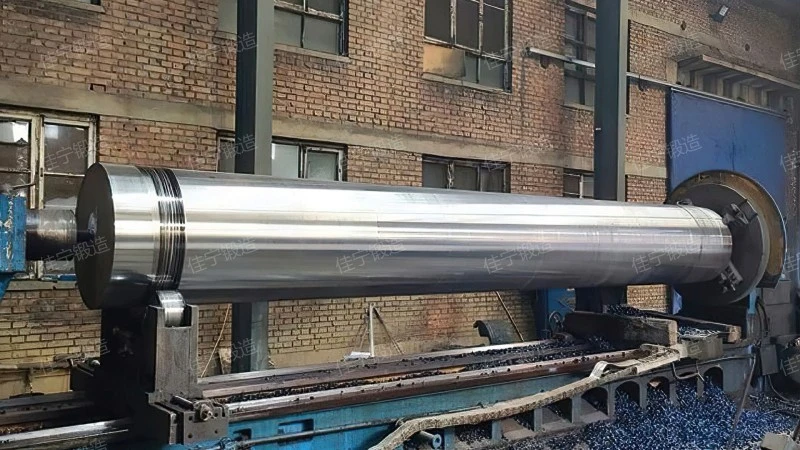
To illustrate the practical application of these criteria, consider a recent project where a European marine engineering firm needed 12-meter-long nickel alloy propeller shafts for a new ice-class vessel. The alloy specified was Inconel 625 for its exceptional pitting resistance in cold seawater. After initial screening of seven forging factories, the client shortlisted three potential suppliers. One factory, Jianing Forging, provided a comprehensive proposal that included a full metallurgical roadmap: VIM+VAR melting, a 4:1 forging ratio on a 4,000-ton press, multi-step solution annealing at 1,120°C with water quenching, and 100% phased array UT with a 1.2 mm reference hole sensitivity. The client conducted an on-site audit and verified that the factory's UT technicians held SNT-TC-1A Level II certifications. The delivered shafts passed all acceptance tests, including a 10-cycle thermal shock test from −20°C to +150°C and a torsional fatigue test exceeding 1 million cycles without failure. The project was completed two weeks ahead of schedule, and the shafts have been in service for over three years with no corrosion or cracking incidents. This case underscores that a factory with documented process control, rigorous NDT, and a transparent audit trail can deliver reliable performance even under the most demanding service conditions.
Trends Shaping the Nickel Alloy Forging Industry in 2026
Staying informed about market and technology shifts helps you ask the right questions during supplier evaluation. In 2026, the nickel alloy forging industry is experiencing three major trends:
- Adoption of digital twins and simulation: Leading factories now use finite element analysis (FEA) to simulate forging flow lines and predict potential defects before a single billet is heated. This reduces trial-and-error costs and improves first-pass yield to above 95%.
- Near-net-shape forging for additive manufacturing hybrid parts: Some manufacturers combine closed-die forging with laser metal deposition to create shafts with integral flanges or collars, minimizing material waste by up to 40%.
- Sustainability requirements: Customers increasingly demand environmental product declarations (EPDs) showing the carbon footprint of forged shafts. Factories using electric arc furnaces powered by renewable energy or implementing waste heat recovery can offer lower embodied carbon—a growing differentiator in regulated markets.
When you select a forging partner, ask about their digitalization roadmap and sustainability initiatives. A forward-looking factory will be transparent about their energy consumption per kilogram of forged output and their plans for emissions reduction.
Final Steps: Making the Selection Decision
After gathering technical proposals, audit reports, and commercial offers, compile a weighted decision matrix. Assign scores to criteria such as metallurgical capability (30%), quality certifications (20%), on-time delivery record (15%), cost competitiveness (15%), and after-sales support (20%). Schedule a call with the top two factories to discuss any remaining questions about heat treatment cycle guarantees or emergency response times. Request at least three customer references from projects similar in size and alloy specification to yours. Speak directly with the end-user engineers—not just procurement contacts—about their experience with repeat orders. Finally, before signing a contract, ensure the factory agrees to include specific acceptance criteria in the purchase order, such as maximum inclusion size (e.g., no inclusions larger than 0.5 mm per ASTM E45), hardness uniformity range, and agreed-upon dimensional tolerances. By following this systematic evaluation process, you will select a forging factory that delivers nickel alloy shafts meeting your technical requirements while building a foundation for long-term supply reliability.